


Alternative Capital Onboarding & Account Architecture
Company: Invest Clearly
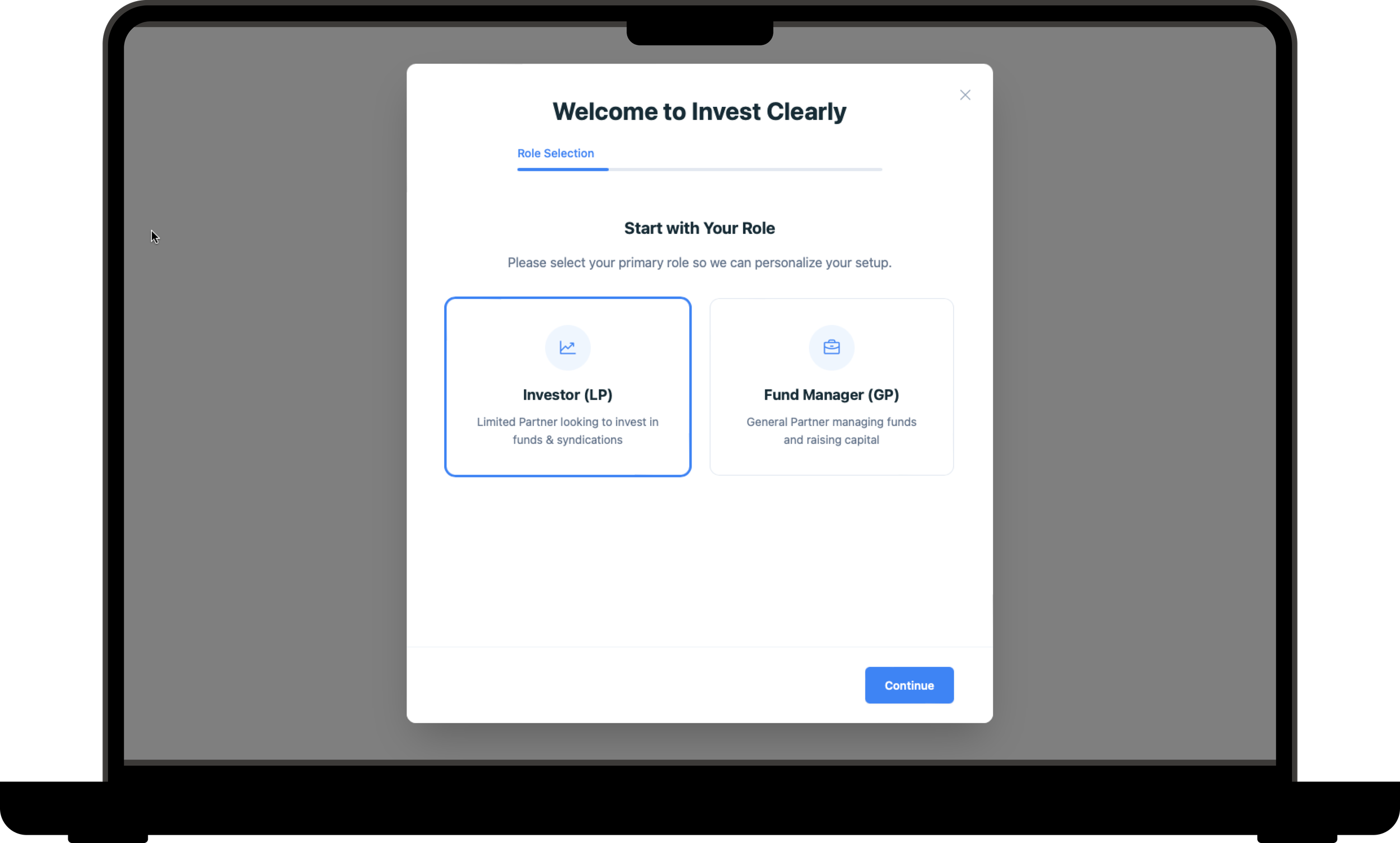
Scale: Multi-Asset Private Capital Marketplace | High-Net-Worth Individuals (HNWIs) & Institutional Allocators
The Symptom
The Systemic Bottleneck: The platform's legacy experience was gated by an intrusive data-acquisition workflow. This "Give Before You Get" interrogation demanded sensitive financial metrics and explicit net worth thresholds prior to delivering platform value.
Consequently, the system triggered prohibitive top-of-funnel drop-off and compliance fatigue among high-net-worth allocators.
The Outcome
The Architectural Output: Engineered a unified, multi-track ingestion pipeline and a segmented post-login app shell inspired by best-in-class database models. By shifting the core data schema to retrospective relationship mapping and integrating an asynchronous, sponsor-driven verification engine, the system automatically validates allocator credentials, unblocks top-of-funnel velocity, and eliminates engineering implementation drift via an automated, code-verified design system workflow.
01/ The Closed-Loop Ecosystem & Relational Framework
In alternative asset networks, top-of-funnel conversion is routinely destroyed by treating user initialization as an administrative audit. The legacy Invest Clearly onboarding architecture treated onboarding as an isolated, linear web form that stored abstract, forward-looking user preferences. This approach generated zero immediate platform signal, network utility, or structural trust.
To capture high-net-worth capital allocators, the system model was re-architected into a three-part closed-loop data engine:
The Relational Ingestion Pipeline: Splits users by intent-driven roles and converts the data model from hypothetical user preferences to factual, retrospective relationship mapping.
The LP Engagement Hub: A multi-page, post-login destination structured on a segmented account matrix ("The G2 Model") to eliminate cognitive overload and dynamically adapt layouts based on user state.
The Sponsor Verification Vault: An asynchronous, sponsor-facing verification infrastructure that allows fund managers to pre-verify investor databases, matching verified records directly to inbound user emails to completely bypass manual verification gates at sign-up.
The Algorithmic Competitive Synthesis
To rapidly map the competitive paradigm without manual audit lag, I deployed an automated scanning workflow to isolate onboarding patterns across two competing verticals:
Enterprise Investment SaaS: Characterized by hyper-regulated, document-heavy workflows with a legalistic tone.
The Constraint: Introduced prohibitive drop-off vectors for a voluntary user network.
B2B Review & Data Platforms: Dominated by low-friction viral loops and rapid "claim-profile" mechanics.
The Constraint: Suffered from a casual, low-trust execution that alienated high-net-worth operators.
The Strategic Position: The system architecture was locked precisely in the middle—merging the velocity of a review ecosystem with the security parameters required by alternative finance.
02/ Programmatic Specifications & Logic Pre-Validation
To shield engineering squads from requirements ambiguity, the system initialization paths were broken down into deterministic, rule-based modules.
Before committing to high-fidelity UI rendering, I ran low-fidelity structural logic validations using Gemini to generate structural ASCII wireframes. This allowed the cross-functional team to evaluate the raw information architecture and "Search + Add" sponsor selection patterns completely sterile of visual distractions.
+---------------------------------------------------+
| [Progress Bar: Step 2 of 3]                       |
| Who have you invested with?                       |
| +-----------------------------------------------+ |
| | [Search Icon] Search for a sponsor or fund... | |
| +-----------------------------------------------+ |
| [-- Your Selections --]                           |
| [x] Blackstone                                    |
|                                                   |
| Don't see them? [Add a new sponsor]               |
+---------------------------------------------------+
I then used Gemini to run systematic "logic red-teaming" across the proposed wireframe paths to stress-test edge cases and routing boundaries.
The Intercepted Edge Case: This automated logic audit immediately exposed a critical system dependency: if an allocator's specific sponsor was absent from our database, the user path hit a dead end.
The Structural Mitigation: We designed an asynchronous "Add-a-GP" override path directly into the selector interface. This edge-case handler captures net-new institutional metadata on the fly without fracturing the onboarding loop or breaking session momentum.
03/ Tokenized Design Systems & Lexical Trust Tuning
To scale the design system while maintaining mathematical consistency, global design tokens were encoded directly into our visual foundation workflows using prompt-driven generation parameters.
Generative UI Constraint Engineering
Instead of manually drawing components from a blank canvas and risking style drift, structural tokens were defined programmatically within the generation layer to enforce rigid layout limits:
The Canvas Palette: Page background strictly limited to a light gray anti-fatigue token (#F1F5F9).
The Layout Core: Main interactive cards bounded to a centralized white card of a strict 560px width with a soft shadow to optimize cognitive focus.
The Call-to-Action Anchor: Persistent top header layout containing a dedicated interactive action token (#3E84F4 Primary Button) to consistently incentivize platform review ingestion.
Lexical Trust-Tuning Matrix
In premium asset platforms, uncalibrated interface copy is interpreted by high-net-worth users as operational risk. I systematically audited the copy architecture using Gemini against my clinical Trust Framework to ensure maximum psychological safety.
04/ Multi-Path User Ingestion & Routing Orchestration
To balance rapid user activation with rigid institutional compliance needs, the platform onboarding architecture was segmented into three high-velocity, single-intent user paths:
Relationship Mapping
Capitalizes on immediate user intent to seed core platform review data.
Supply-Side Growth
Automated claim mechanics to safely scale network visibility.
Friction Offloading
Inverts traditional onboarding constraints to capture critical value first.
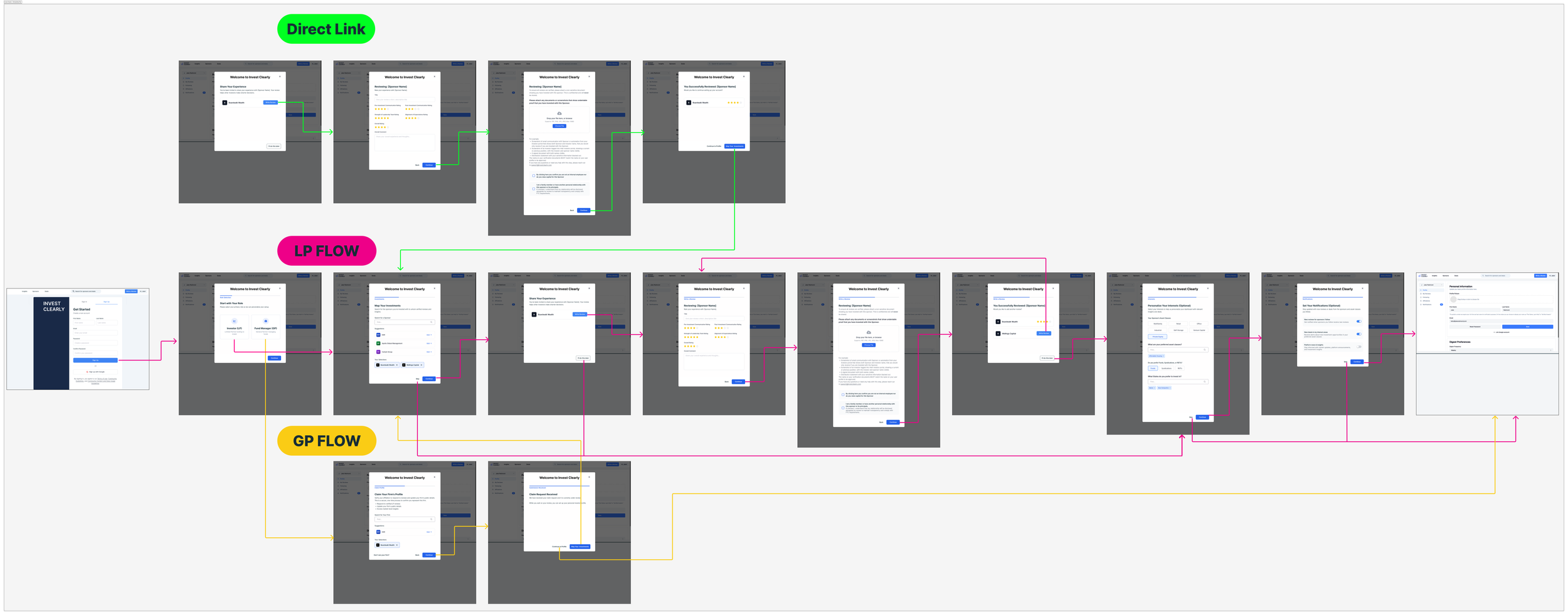
System Logic Blueprint: The Relational Node-Mapping Flow
Mapping the conditional routing logic required to bypass manual compliance checks and dynamically segment users based on their verification state.
05/ The Operational Outcome & Code-Validated Handoff
To eliminate implementation drift and ensure complete functional alignment with the system design constraints, I utilized Gemini to compile our validated interaction parameters directly into a browser-executable code prototype (onboarding_handoff.html and hub_current_state_ready.html). By delivering production-optimized semantic HTML5 wrapped in utility-first Tailwind CSS classes, the final handoff format bypassed traditional static redline delivery entirely.
Frontend development squads were able to ingest the responsive layout matrices and interactive component states directly into the live Next.js development sandbox. For post-production quality assurance, downstream engineering squads utilized DOM inspection routines via the html.to.design pipeline to verify that live browser layouts perfectly matched editable design constraints.
This code-first pipeline guaranteed that all structural layout rules, complex conditional states, and lexical trust-tuned microcopy survived production deployment intact.
The Execution Leverage:
Zero Translation Drift: Delivering pre-coded, interactive browser-validated files compressed the design-to-engineering handoff cycle to zero interpretation gaps.
Top-of-Funnel Conversion Optimization: Shifting the core data collection to retrospective node assignment completely bypassed compliance friction, eliminating user anxiety and data hesitation.
Pre-Verified Network Growth: Programmatically matching pre-verified sponsor CSV uploads directly to inbound user identities removed manual compliance checks, creating a self-sustaining pipeline for high-value platform data ingestion.
<div class="max-w-[560px] w-full bg-white border border-slate-200 rounded-md p-8">
  <div class="w-10 h-1 bg-[#3E84F4] rounded-sm mb-4"></div>
  <h4 class="text-[#172C36] font-bold text-base mb-2">Verify Affiliation</h4>
  <p class="text-slate-500 text-xs font-medium">
    This is a secure, one-time process.
  </p>
</div>
Implementation Telemetry
06/ Strategic Synthesis & Native Interface Execution
The final interface isn't just a fresh coat of paint—it is the direct execution of our behavioral constraints and backend data models. We killed the high-friction, "give before you get" interrogation. Instead, we built a relationship-first network utility that prioritizes high-intent facts (historical relationships) over low-value hypotheticals (future preferences).
Every UI component, microcopy string, and layout token was engineered to eliminate cognitive load and protect top-of-funnel velocity for high-net-worth operators.
Native CSS Component Specification
We eliminated the gap between visual intent and frontend reality. The interface below is a fully responsive, native HTML/CSS component that perfectly executes the Tailwind layout tokens and trust-tuned copy defined in our system architecture.
System Blueprint Architecture
By leveraging AI for rapid logic validation and strategic synthesis, we compressed the design timeline and ensured every interaction was grounded in psychological trust principles. The final onboarding architecture stands as a fully documented, risk-mitigated technical asset that completely reorients the platform's data ingestion model:
From: A high-friction Compliance Interrogation demanding upfront net worth and AUM metrics before granting platform access.
To: A low-friction Relationship Map that verifies historical partnerships to instantly unlock targeted network data.
The Result:
A streamlined onboarding flow that prioritizes high-value facts over low-value preferences—positioning Invest Clearly as the verified source of truth in the alternative investment market.